
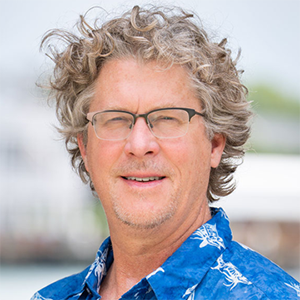
“Study nature, not books,” is one of ecologist Brian Silliman’s guiding principles and favorite phrases. It’s a quote from 19th-century naturalist Louis Agassiz that is (wonderfully, hilariously) on a sign outside a library at Woods Hole Oceanographic Institution in Massachusetts. That’s not to say Silliman doesn’t also love books. The Rachel Carson Distinguished Professor of Marine Conservation Biology and Director of the Duke Wetland and Coasts Center in the Nicholas School of the Environment started his academic career as a double major in history and science at University of Virginia.
PhD students in my lab go out into an ecosystem and try to figure out what are the most important interactions that control that ecosystem’s resilience. They then take that knowledge and apply it to the design of how you restore that ecosystem.
“The great thing about studying the humanities is that they teach you to question everything where science teaches you to conform to everything. That’s just the way it is. My lab, my students and I, we’ve had a lot of papers that have been paradigm changing and I attribute that to the fact that we spend a lot of time in the field. We ask nature, not books, how things work. Of course, this then creates a feedback where we seek to focus on areas where nature tells us something different than books. When it does, we revise understanding. Confronting theory with real data from nature to see if it’s right or wrong is one of our favorite things to do.”
Silliman’s background also informs how he discusses his research. He likes to describe ecological systems the way an economist might describe a marketplace, as a dynamic system where a few key actors can set the tone for everything else. “Species are interacting everywhere, through competition, predation and partnerships, but there are a few levers, or species interactions, that are way more important than the others. If we pull them, you can help shape the whole structure and function of that system. Thus all species are not created equally,” he says. Silliman has built his career uncovering those levers, the species interactions that determine how an ecosystem thrives or collapses.
In a recent paper in Nature, Silliman and his team demonstrate how sea otters, a natural predator, keep the ecosystem in balance by eating a quarter of their own body weight in crabs every day. This crab diet indirectly allows the salt marshes to grow and stabilize, since crabs “proliferate and devour the marsh plants. They eat the roots and riddle the marshes with burrows, actions that both cause severe creek bank erosion,” setting off a chain of marsh decline, as chunks of marsh fall into the sea. With otters in the system, plants can return and thrive, shorelines can be rebuilt and stabilized, and biodiversity flourishes. “Otters are a keystone species,” Silliman explains. “They drive trophic cascades that ripple through the system.” Reintroducing them is not only ecologically powerful but much, much cheaper than significant engineering solutions like adding sediment to marshes.
The otter example is one of competition, predators and prey, resources and consumers, supply and demand, a typical economic and ecological way of understanding natural systems. But Silliman also explores “mutualisms,” positive interactions, or partnerships, between species that may have beneficial effects on the actors. “For a long time, ecology focused on competition and predation,” he says. “Competition is of course a driving force, but often it’s these strong positive interactions that are the primary reason ecosystems can develop and persist over time. It’s only after that mutualism that competition structures the system.” For example, Silliman and his students have discovered that the primary reason southeastern US salt marshes don’t collapse and turn into mud flats with massive droughts is due to a mutualism marsh plants have with mussels in their roots. The mussels bathe the plant’s roots in nutrient rich “mussel poop” and oxygenated water, increasing their ability to resist death due to intense drought. In addition, mussels attract mud crabs that burrow around them for a home. In turn those mud crabs eat plant grazing snails, adding another layer of resilience. Mussels increase drought tolerance and recovery of the plants that build the ecosystem, upon which all other services are generated, like fisheries production, erosion suppression, and improved water quality.
These insights inform Siliman’s leadership of Duke Restore, an ambitious Nicholas School initiative that seeks to reimagine how we can rebuild ecosystems. Duke Restore designs restoration projects that deliberately harness or mimic these foundations. And biological partnerships. For instance, they cluster, rather than separate, organisms with their natural partners—trees with microbial fungi, marsh grasses with crabs, corals with mussels. “PhD students in my lab go out into an ecosystem and try to figure out what are the most important interactions that control that ecosystem’s resilience. They then take that knowledge and apply it to the design of how you restore that ecosystem. We’re maximizing regrowth by minimizing competition and by harnessing all the positive relationships organisms need to build an ecosystem. If you leave out those partners, you set the system up to fail,” he says. By rebuilding with these relationships in mind, restoration becomes more resilient.
Climate impact makes the work even more urgent. Silliman notes that stressors like heat, drought, and salinity shifts are already reshaping species interactions, sometimes with devastating consequences. But his research has also shown that more predators and mutualism can actually increase an ecosystem’s ability to withstand climate stress. And the effects are not small, increasing climate stress tolerance of foundational organisms like marsh grass, corals, seagrasses and oysters by 10-50%. That knowledge helps Duke Restore design projects for the future, including planting heat-resistant species and exploring genetic innovations that could give vulnerable ecosystems a fighting chance.
For Silliman, the goal is not just to restore ecosystems to what they once were but to rebuild them for the conditions ahead. “Nature has already given us the tools,” he says. “Our job is to learn from those partnerships and scale them up.”
Photos courtesy of Nicholas School of the Environment.