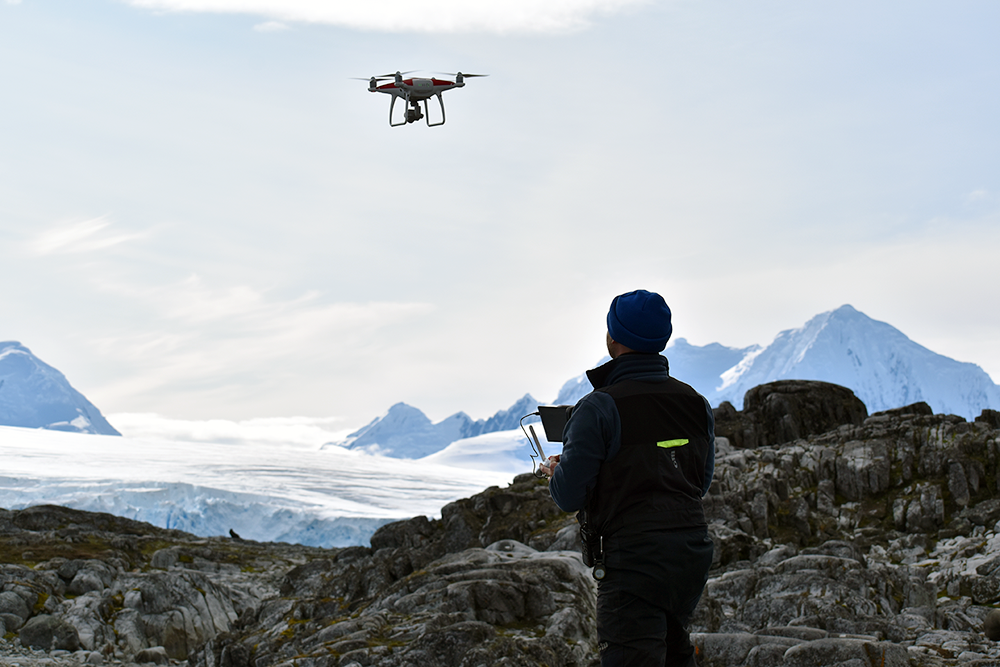
Greg Larsen’s journey from seal researcher to drone pilot began at the Duke Marine Lab, where he joined marine ecologist David Johnston’s newly established Marine Robotics and Remote Sensing Lab as a doctoral student.
With no prior experience, Larsen earned drone pilot certification from the Federal Aviation Administration and trained extensively to master drone safety in harsh conditions—skills that proved essential during a research expedition to Antarctica. Tasked with collecting whale data, Larsen, who earned his Ph.D. in 2022, expanded his focus to seals and environmental mapping. Over three summers near Palmer Station, his team documented shifting weather patterns and ecological changes, producing detailed maps of vegetation, glacial melt and wildlife. Inspired by the rich data, Larsen and Johnston launched a Bass Connections project: Biogeographic Assessment of Antarctic Coastal Habitats. The interdisciplinary program engaged Duke students in GIS training and original research on species like fur seals, Adélie penguins and giant petrels, as well as land cover changes. Their work led to multiple publications and a publicly available aerial data repository still used by Antarctic scientists. READ MORE.
Flying a drone in Antarctica. Photo courtesy of Greg Larsen.