
Climate and Health
Why It Matters
Global climate change is impacting human health in myriad ways: by altering food systems, heat impacts, migration patterns, water and sanitation, infectious disease vectors, and more. Mobilizing the whole university to address climate challenges is serving to break down historic silos between “health” and “campus” and strengthen the interdisciplinarity across schools and units to address urgent health issues. Plus, Duke is working with Duke Kunshan and Duke-NUS on this important global challenge.
Education
Duke is shaping professions and policies to meet climate and health challenges. We are engaging students—undergrad, master’s, and Ph.D.—in our climate and health research and as an essential component to experiential learning. Our efforts combine the Duke University Health System, high-caliber School of Medicine and School of Nursing, all of which work in partnership with the Duke Global Health Institute.
Student Spotlight:
Elizabeth Rojo, Ph.D. Student
Elizabeth Rojo is pursuing a Ph.D. in Population Health Sciences. Her research interest lies at the intersection of climate change and health inequities. She is currently researching heat-health implications in the U.S. farmworker community. She also co-leads the Climate X PopHealth Working Group within the Department of Population Health Sciences and is membership chair for the APHA Latino Caucus for Public Health. Elizabeth has worked domestically and internationally co-developing and growing projects in Mexico, Tanzania, Ghana and the U.S.

Research
Duke research is leading the way in identifying climate stresses on both health care and health outcomes, on new diseases and new patterns of old diseases, on individuals and populations, and on consequences for health equity. Leveraging an evidence-based, interdisciplinary approach that spans basic science, translation, clinical and population health, and by drawing on Duke’s many assets, infrastructure, and partnerships, we aim to reduce climate-induced health threats, increase the resilience of individuals and communities and support smart policies. The Duke Global Health Institute, Duke Kunshan and Duke-NUS are key parts of this climate theme.

Duke School of Medicine
Health experts at the Duke University School of Medicine are scrutinizing the myriad ways in which shifting environmental conditions, from sweltering temperatures to severe storms, shape our well-being. Their efforts involve pinpointing solutions to help those susceptible to environmental disruptions, which could affect respiratory and cardiovascular health, food security, infection resilience, and mental health.

Heat Policy Innovation Hub
Over the last 30 years, heat exposure has killed more people in the United States than any other weather-related phenomenon. The Heat Policy Innovation Hub is the first program in the United States dedicated to cross-disciplinary innovation on extreme heat policy and practice. The hub brings together scientists and communities to develop and deploy innovative policy solutions that reduce the impacts of extreme heat on human health and well-being.

Climate X PopHealth
The Climate X PopHealth Working Group develops and implements effective, evidence-based solutions to mitigate the impacts of climate change on human health. The group promotes population health resilience by supporting an interdisciplinary network of collaborators across the Department of Population Health Sciences (DPHS), Duke University, and the community at large.

Nicholas School of the Environment
Environmental health research at the Nicholas School of the Environment focuses on the impacts of the natural and built environment on both human and ecological health. It encompasses fields including ecotoxicology, exposure science, environmental chemistry, environmental exposomics, environmental epidemiology, water quality, climate change and natural resource management.

School of Nursing
Duke University School of Nursing is committed to advancing health equity and social justice by preparing nurse leaders and innovators through transformative excellence in education, clinical practice, and nursing science. The school joined the Nurses Climate Challenge, a national campaign to educate 50,000 health professionals on the impacts of climate on human health.

Data Expeditions: Climate and Health
Climate Data Expeditions: Climate and Health brings together Duke expertise to improve health by drawing on data to inform problem definition and design of solutions. Because health impacts of climate change are mediated by interrelated environmental conditions, environmental exposures, and a host of social and behavioral factors, transdisciplinary teams are exploring solutions.
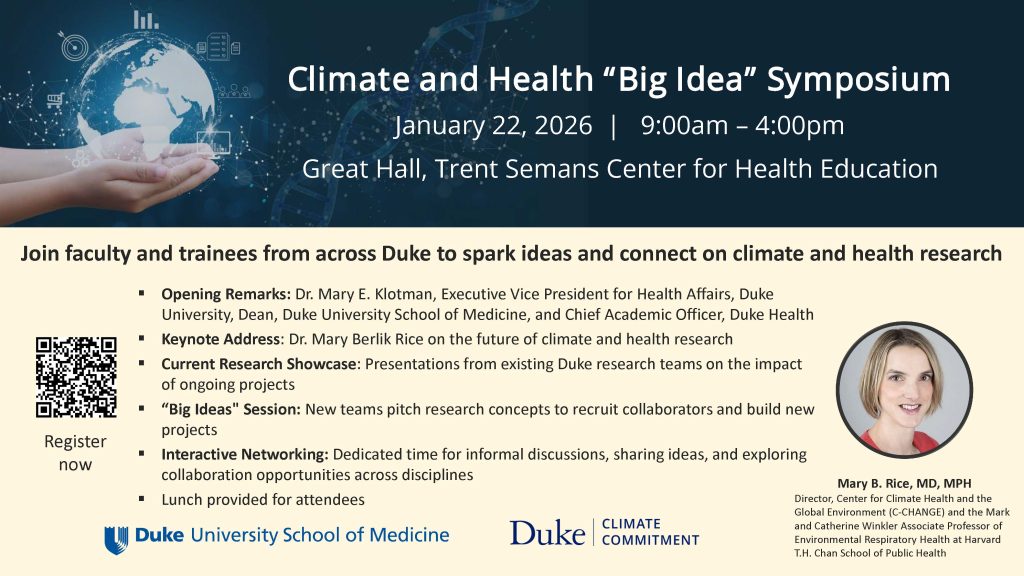
Climate & Health “Big Ideas” Symposium
The inaugural Climate & Health Big Idea Symposium on Jan. 22 is open to the Duke community and invited guests, and will serve as a platform to accelerate bold ideas, showcase emerging collaborations, and catalyze new partnerships across Duke and beyond.
Community Partnerships
By fully integrating Duke’s first-class academic health system into the Duke Climate Commitment’s education, research, engagement, operations, and community partnership strategies, we have an unprecedented opportunity to improve the lives of the local Durham community as well as people across the globe.
Cooling Communities
Extreme heat is placing growing pressure on communities across the Carolinas. Enter “Cooling Communities.” This initiative brings together community leadership, trusted faith-based institutions and financial innovation.
News and Media Mentions
Featured news and stories about climate and health at Duke University

Duke Today: Climate Change and the Brain
This Duke Today feature explores growing research into how climate change and air pollution affect the developing brain.

Duke Video: Extreme Heat
Ashley Ward, who directs the Heat Policy Innovation Hub, urges municipal leaders and policymakers to treat extreme heat with year-round urgency in this video.

School of Medicine: Climate and Health Strategy
Read this Duke School of Medicine feature on the future of climate and health.
Faculty Highlights
There are faculty working in multiple schools, departments, schools and units across Duke on climate and health. Visit the School of Nursing, School of Medicine and the Nicholas School of the Environment for even more connections.


